
Puno Filter / Guides / What a sterilizing filter is
What a sterilizing filter is
A sterilizing-grade filter is a membrane filter, rated 0.2 or 0.22 micron, that has been shown to remove bacteria completely from a liquid or gas under a standard challenge.
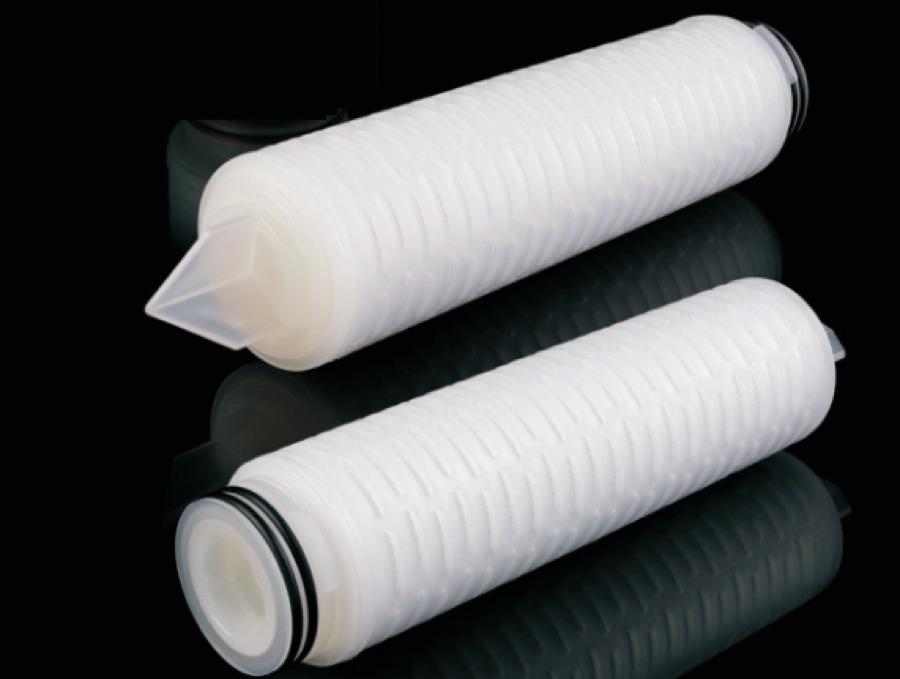
What makes it sterilizing grade
The rating alone is not enough. The filter type has to pass a bacterial challenge: a small test organism, Brevundimonas diminuta, is fed to the filter at ten million organisms for every square centimetre of membrane, and the liquid that comes out must be sterile. The method is described in ASTM F838.
How you know each filter is good
You cannot challenge every cartridge with bacteria, so each one is given an integrity test that is correlated with the challenge:
- Bubble point: the pressure at which gas first pushes through the wetted membrane. A low value means a defect or the wrong pore size.
- Diffusion or forward flow: the small gas flow through a wetted membrane below the bubble point.
- Pressure hold: how fast pressure decays on the upstream side.
- Water intrusion: used on hydrophobic vent filters, which do not wet with water.
Plants test before use, after use, or both, depending on the rules they work under.
Which membrane
- Water-based liquids: PES, for high flow and low protein binding.
- Gases and tank vents: hydrophobic PTFE, which stays dry and keeps the vent open.
- Solvents and aggressive chemicals: PTFE.
Validation
For a drug product, the filter also has to be validated with your own liquid: that bacteria are still retained in it, that the liquid does not damage the filter, and that nothing harmful leaches out. The factory's laboratory can run those studies. See quality and testing.
Request a quote
The more you can tell us about the duty, the closer the first quote will be. A photo or model number of your current cartridge is enough to start.